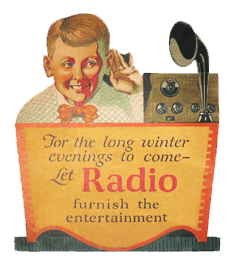
Guglielmo Marconi had been developing ideas for an invention that would replace the wired telegraph to help insure the safety of ships at sea, and in 1901 the first broadcast was made in morse code by Marconi in England to Newfoundland in Canada. This was the first wireless transatlantic broadcast ever sent and recieved.
In 1906 inventors decided to develop the wireless telephone in order to add humanity to the transmissions to ships, but other inventors such as Marconi disagreed with this as the messages wouldn't be private.
In 1906 Fessendon used wireless telephone technology of his invention to make a pre-announced broadcast himself playing the violin and reading the bible, he did this in order to seek finacial backing for his invention.
In 1907 De Forest made two important demonstrations of the wireless telephone by giving the navy a wireless telepone and an arc transmitter in order to broadcast phonograph records to shore stations, he also broadcasted well-known opera singers to reporters in New York because he wanted to bring culture into homes.
By 1920 some volunteer radio stations had started broadcasting in the United States and in January the first informal and spasmodic broadcast, including both speech and music, was made by the Marconi Company from Chelmsford. The first news broadcast was also this year, it was from Detroit using news from the Detroit newspaper. In 1922 the Marconi Company was allowed to set up a broadcast station in London, which was later taken over by the British Broadcasting Company (BBC).
Up until 1945 radio was highly unreliable due to interference, and international telephone calls were very expensive the but author Arthur C Clarke wrote an article describing a way to use satellites to transmit radio signals all over the world, this was a revolutionary idea which would take years for the technology to be available.

In 1957 Sputnik 1 was launched. Sputnik 1 was a satellite launched by the USSR that transmitted a beep, they did this to prove that satellites could be successfully put into orbit. Over time, many other satellites were also launched into orbit and pirate radio stations were formed. BBC Radio 1 was launched in 1967 and would go on to form the foundations of radio programming to this very day.
Radio Drama is storytelling broadcast via the medium of radio. As radio drama is purely audio all of the themes and emotions have to be expressed using dialogue, music and sound effects.
Radio drama became popular in the 1920s and by the 1940s was the leading form of popular entertainment internationally. In the 1920s people began to tune into radio dramas rather than reading books, playing games or seeking other forms of entertainment, examples of very early radio dramas are; 'Lights Out' and 'Danger'. In the 1950s people began to buy into television and so the popularity of radio drama disintegrated in some countries, but continued to thrive here in the UK.

The first recorded english spoken radio drama was 'A Rural Line on Education', this was broadcast on the american radio station KDKA in 1921, but one of the first radio drama broadcasts in the United Kingdom was the 'Danger' by the BBC in 1924. The French radio drama 'Marémoto', also known as 'Seaquake' was considered one of the most influential of the time but wasn't allowed to be broadcast in France because the government believed that the SOS messages in the drama would be mistaken for real distress signals.
 One of the most famous radio dramas ever to be broadcast was Orson Well's 'The War Of The Worlds' in 1938. The recording was from a H.G. Wells novel about an alien invasion on the earth. The broadcast was an hour long and included simulated news bulletins stating that aliens were attacking the earth, these fake bulletins scared listeners because they thought the programme was factual but adverts were inserted during runtime to clear up any confusion. Afterwards the programme got a lot of bad press because it had been misunderstood and people thought it was deceptive.
 Other famous radio dramas to be broadcast are 'The Hitchhiker's Guide to the Galaxy' and 'The Twilight Zone'. The Hitchhikers Guide to the Galaxy was first broadcast in 1978 up until 2005, and it is still sometimes on. The award-winning science fiction/comedy programme lasted 26 episodes and was broadcast both in the UK and in America.
The Twilight Zone was originally a television programme but was converted for radio and was first broadcast in 2002. The series was broadcast on the radio in America but can be listened to online also.
'The Archers' was created by Godfrey Baseley who has written over 16,000 episodes, and it is one of the longest running radio soaps. It was first broadcast on the BBC Light Programme, then on the BBC Home Service and it is now broadcast on Radio 4. The Archers is set in rural England and is about a middle class family who own a farm.
Another poignant radio drama was 'Mrs Dale's Diary', the drama is poignant because it was broadcast from 1948 until 1967 and it addressed sensitive issues of the time, such as homosexuality. It was about a middle-class Doctor's wife who kept a diary of her daily affairs and one of the starring characters was a homosexual, this is significant because homosexuality was still illegal here in the UK until 1967.

The invention of television may have stifled the popularity of radio somewhat but for some programmes radio was a doorway to televison, and therefore to more fame. Television programmes and films that started as radio programmes include 'Little Britain' and 'The Hitchhiker's Guide to the Galaxy'.

No comments:
Post a Comment